The Blue Route Attends 2018 FUSE Conference on Resilience

Susquehanna University hosted the sixth annual Forum for Undergraduate Student Editors (FUSE) conference at the beginning of November 2018. FUSE is a national organization that provides a network for undergraduate student editors and writers and their faculty advisers. The three-day conference brought together about 60 students from 13 universities for a series of writing and editing workshops and panels centered around the theme of representation and resistance.

The conference aimed to display the importance of understanding resilience within the publishing and editing industry in “an age of political disparity, mass digitalization, and hyper-information.” Each workshop was dedicated to speaking out about challenges in our members’ publishing and editing endeavors and exploring solutions to rise above, whether it be through UCLA’s “Finding and Emphasizing Character Resilience,” Gettysburg College’s “Politics for the Apolitical Literary Magazine,” or SUNY Geneseo’s “Resilience in Writing: How to Keep Writing When You Feel Stuck”.

Poet and activist Martín Espada return2018110195195432951541788035627ed for the second year in a row, kicking off the conference with a captivating reading of his poems, which “explore the immigrant and working class experience.” He read passionate poems from his published works as well as moving poetry in response to today’s political climate. Espada also hosted a workshop on identity where he encouraged students to write and present their own poems on reclaiming identity, the literal meaning of their names, or the differences between their names and what they represent.

Andrew Ciotola, managing editor and book review editor of West Branch, Bucknell University’s nationally distinguished literary journal, joined FUSE along with Jessica Hensen and Caitlin Friel for a panel and Q&A session regarding West Branch, the publishing industry for online and print publications, and the editorial profession. During the panel, Ciotola stated “literary magazines are a service for the writers” and assured books are as popular now as they have ever been and they need editors.

Dr. Cheryl E. Ball, director of the Digital Publishing Collaborative at Wayne State University and editor of Kairos: A Journal of Rhetoric, Technology, and Pedagogy, also gave an engaging lecture on “Digital Publishing and the Liberal Arts”. During her lecture, Dr. Ball shared her journey, the relationship between creative writing and digital writing, and reminded those in the audience that “getting things done is not the same as having a vision.”
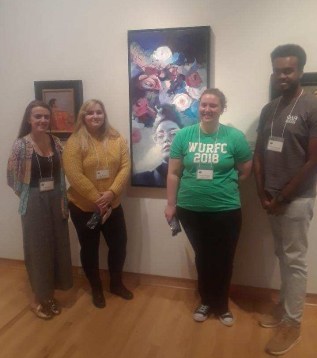
2018110195205609951541788043357Widener University was represented by Kelly Bachich, Sarah De Kok, Carlie Sisco, and Rohan Suriyage along with several of their professors. Below are reviews from Widener representatives regarding the 2018 conference:

Kelly Bachich
The FUSE conference this year was a much needed reminder of the importance of having a community for undergraduate writers and editors. It was my first year attending and I was lucky enough to be afforded the opportunity of presenting on a panel with fellow Widener senior, Carlie Sisco. This experience was invaluable in what it taught me about public speaking and sharing my journey. The support we received from attendees during and after the presentation was a much needed pat on the back for us as we press on for bigger and better things for our campus literary journals. While the other panels and workshops were wonderful, my favorite part about the conference was the camaraderie between the students having just met from all over. At the student-led open mic, everyone wanted to share their journey with us and trusted us with it from up on stage. It’s important to feel like you are a part of something and, at FUSE, we did.

Sarah De Kok
Hearing Martín Espada read his work was a magical experience. I had the pleasure of sitting in the second row, right in front of the podium where he was reading. His voice was deep and passionate. If he were to record an audiobook of his poems, I would listen to it in a heartbeat. I felt a sense of inspiration at the poetry workshop he held the next morning. We were instructed to write a poem about our names in forty-five minutes. Everyone spread out to different corners of the room or even left the room to find a comfortable place to write. I took a few minutes to think about what I wanted to write, then started writing. I tried not to concern myself with whether or not it was “good”. I just wanted to get my thoughts down. After the forty-five minutes, we all regrouped back into the conference room. Some people read what they had written. It was amazing to hear what people were able to create in forty-five minutes. I will remember this experience every time I think I don’t have enough time to write. All I have to do is set a timer and start writing.

Rohan Suriyage
I typically feel like I’m pretty comfortable reading in front of people, but it was something about that Friday morning at Susquehanna, reading a poem I wrote about myself in 30 minutes to a full room of people and Martín Espada sitting behind me that had me near shaking. Looking back, I think it was being a newcomer to the conference scene for things regarding the English major. As a whole, I was pleasantly satisfied with the conference and the experiences of other schools with their respective literary journals, seeing students like me construct panels and presentations to communicate their knowledge and research. By the end of the conference, I left with a more substantial appreciation and understanding of student writing, editing, and publishing. I even feel like my desired career path with research and education is more concrete as well. I’m still interested to see how other schools and their English and Creative Writing programs operate and, after my conference experience, I’m craving another opportunity to interact with those like me.

Carlie Sisco2018110295121618951541788090798
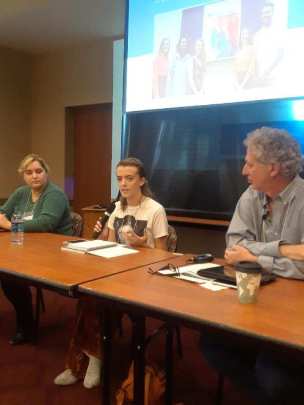
Attending the 2018 FUSE conference felt very much like reuniting with old friends, but I think that is bound to happen when you surround yourself within a positive environment of talented, passionate, creative individuals. I had the opportunity to attend FUSE for the every first time in 2017 where I got to run a workshop with several of my peers on writing resistance monologues and experience the community I am so proud to be a part of. This time was no different. Fellow editor and senior, Kelly Bachich, Professor James Esch, and I had the chande to present the topic of institutional support at our own panel, creating an open discussion bout challenges, trials, and ways to persevere as well-respected literary journals within our colleges and universities. Each panel at the conference did just that: start a dialogue between like-minded individuals, faculty members, advisors, and students alike. I think that is the most important and valuable part of FUSE. This is a place where creators can freely generate, share, and discuss new ideas, where you can be vulnerable with complete strangers and only feel the upmost support. You leave a conference like this with prompts, tools, ideas, suggestions, sometimes new conent, perhaps a new friend, and a renewed sense of love and hop for the writing world.


This slideshow requires JavaScript.

by Carlie Sisco

Pulitzer Prize Winner Geraldine Brooks Captures Acceptance and the Hamartia of Humanity

A few years ago, I read a book for an English class I was taking. When I first picked up
the book, I did not think it was going to be something that I would be interested in. Looking back, I can’t believe I ever had that thought. People of the Book by Geraldine Brooks became my favorite novel – and I have read a lot of books! This story has so much depth to it and the themes are still extremely relevant.

Throughout history, people have suffered hateful intolerance. Whether this be caused by
religion, skin color, or gender, it has been revealed that during times of hate some people can come together to accept and support each other while others turn on one another. This is shown in the many stories depicted in Brooks’s realistic fiction novel. The tales in the novel illustrate the impact that a single individual can have on history as a whole.
While there may be violent intolerance, People of the Book incomparably represents interfaith acceptance and humanity’s unwillingness to live and let live.

By portraying different cultures, Brooks displays examples of both multi-ethnic and
interfaith acceptance in her novel and the reader gains a sense of the societal standards at that time the stories take place. This allows the audience to better understand just how brave the accepting the characters were. Hanna Heath, the main character, says it best when she states, “Then somehow this fear, this hate, this need to demonize ‘the other’ —it just sort of rears up and smashes the whole society” (Brooks 195). The Inquisition, Nazis, and extreme Serb nationalists all played a role in creating the hateful intolerance that is present in the novel by bringing about fear through violence toward helpless people.

History has a tendency to repeat itself and People of the Book represents this beautifully.
By showing the repetition of anti-Semitism and hateful intolerance, Brooks represents the beauty in the brave few who persevere through the fear. People of the Book brings to life the history of the Sarajevo Haggadah while teaching valuable lessons of respect and forgiveness. All the while showing the hamartia of humanity —the unwillingness to live and let live.

If you’re still skeptical, give it a chance! It may turn out to be your new favorite novel, too.

People of the Book can be found on Amazon.

If you have any novels that you unexpectedly fell in love with please share with us so we can love them too! Happy reading!

by Allison DeHaas

Why HBO’s Adaptation of “Watchmen” is an Attempt at Adapting the Unadaptable

There’s a reason Watchmen made Time Magazine’s list of the 100 greatest novels of all time. Without a doubt, fans of Alan Moore’s 1986 classic and comic book purists alike will likely despise HBO’s upcoming television adaptation of the famous, graphic novel, whether or not the work holds merit or receives critical acclaim as a TV show.

Simply, Alan Moore taught a generation of comic book authors and fans that the combination of sequential art and dialogue, the comic book, is a unique artform. Since its release, Watchmen has been dubbed the “unadaptable graphic novel.” Watchmen was designed to demonstrate the unique qualities of comic books, and demonstrates these elements in a way that is not just difficult, but impossible to be replicated in any other medium.

For instance, every page of Watchmen is structured on a nine-panel grid layout. This gives each page a central focus, the middle panel, and emphasizes key plot points or artistic renderings in the narrative flow. Issue five of the series, “Fearful Symmetry,” mirrors each page’s panels until converging in the center, which displays a character foiling his attempted assassination. Not a single page of the first 11 issues is a “splash page,” where a single panel makes up the entire page. Instead, the final issue opens with six absolutely breathtaking, haunting, splash pages depicting the destruction of Manhattan.

The emotional impact of these and many other moments is not possible to replicated in other media because Watchmen is not so much about the story being told, but how the story is being told. As Alan Moore said, “If we only see comics in relation to movies, then the best they’ll ever be are films that don’t move.”

I wish HBO the best on the Herculean task they have undertaken. Watchmen is not only the greatest comic book I have ever read, but is one of the greatest works of literature I have encountered. To keep with the original’s artistic integrity, HBO’s Watchmen should utilize the unique elements of television as a medium. Hopefully, the show can succeed on its own merits, if only it allows for more people to experience Moore’s masterpiece.

Creator Damon Lindelof and HBO are set to debut the series in 2019.

by Evan Davis

Submissions Closing October 1!

Just a reminder to all undergraduate students, our submission period for Issue 21 will be closing October 1, 2018.

We accept poetry, fiction, and creative nonfiction from all students currently enrolled in an undergraduate program. Our goal is to find good, highly imaginative writing about contemporary life as you see it!

We do not accept previously published work, but we do accept simultaneous submissions. We also pay twenty-five dollars upon publication.

Get your submissions in to The Blue Route before it’s too late!

For more information, please check out our submission guidelines.

Social Media For Readers

Hi everyone! As we all know, social media plays a big role in a lot of people’s everyday
lifestyles. If you’re anything like me, you go on social media every day! Recently I discovered that there were a lot of social media-based reading opportunities. These are just a couple of fun pages that I have found and enjoy keeping up with in my feeds! If you have some free time, be sure to check them out!

New York Public Library
Instagram: @nypl
Twitter: @nypl
Facebook: NYPL The New York Public Library
These guys post “insta-novels” on their story and in the highlights of their page! It is a fun way to read a quick, classic tale on your social media! Their blog also has great content and insight from librarians, curators, and staff posted daily!

Belletrist
Instagram: @belletrist
Twitter: @belletristbooks
Facebook: Belletrist
This is an online book club! I stumbled upon this page one time and I love it. Even if I’m not able to keep up with what books they are reading, it is awesome to see the titles that are picked and add them to my list of “Must-Reads.” Also, if you go on their website you can sign up to get newsletters from them! They send out book recommendations, author interviews and even quotes of the week!

Lifewire also has a list of 6 Great Book Social Networks and Josh Sterns from Medium compiled 43 Great Literary and Library Twitter Accounts if you are still in need of some awesome literary content!

Do you follow any social media accounts that share literature or art? Let us know so we can check them out too!

Also, don’t forget to check us out!
Instagram: @wutheblueroute
Twitter: @wutheblueroute
Facebook: The Blue Route
Tumblr: theblueroute

See you online!
by Allison DeHaas

Adam Driver Brings Arts to the Military: A Lesson in Language and Self-Expression

In 2015, VICE News followed Adam Driver and a group of fellow actors on a trip to the Middle East. The mission: offering theater to surrounding military bases through an organization called Arts in the Armed Forces.

Driver, a Julliard graduate who has since starred in HBO’s critically acclaimed series “Girls” as well as such films as Star Wars: The Last Jedi, The BlackKklansman, Logan Lucky, Silence, and This is Where I Leave You among many others, began as a United States Marine with 1/1 Weapons Company. Throughout his career, Driver has talked openly about his time in the marines as well as the transition from the military to acting, from soldier to civilian, and the similarities between the two seemingly dissimilar paths.

“In acting school, I was really, for the first time, discovering playwrights and characters and plays that had nothing to do with the military, but were somehow describing my military experience in a way that before, to me, was indescribable,” Driver says in a 2016 TED Talk.

In 2008, Driver founded Arts in the Armed Forces, a non-profit organization dedicated to bringing “high-quality arts programming to active duty service members, veterans, military support staff and their families around the world free of charge.” Arts in the Armed Forces also aims to bridge the divides between “the world of the arts and the world of practical action.”

“We decided to introduce this project where we introduce the military to the theater community and vice versa,” Driver says. “We’re hoping to show that language is a powerful tool, that self-expression is a powerful tool.”

What Driver and Arts in the Armed Forces demonstrates is the inherent need for artistic forms to establish connection or serve as an outlet to convey emotions, whether it be through painting, theater, music, or writing. This demonstrates the inclusivity that the arts has across all genders, races, sexualities, occupations. There is no limit to who is capable of self-expression. There is no limit to how language can impact another human being.

For Driver, the arts and the theater gave him a place and a way to funnel his feelings and his emotions into a constructive, creative, expressive outlet. The arts provided Driver with an expressive language which he, in turn, has encouraged through performances organized by Arts in the Armed Forces. As Driver explains, the arts and his organization offers audiences with a “new means of self-expression,” a vocabulary, and relatable, human characters to carry with them.

Though Arts in the Armed Forces centers on performance art, it is important to remember the artistic language is present in all forms so long as the form allows a person an outlet to expel what is inside themselves. As writers, we express through the written word. It is our escape, our voice, our platform, and our outlet.

Driver believes, “No time in anyone’s life is that bad you can’t place a value on the arts.”

The video below explores Arts in the Armed Forces (joined by Driver, Joanne Tucker, Natasha Lyonne, Eric Bogosian, Peter Scolari, Sasheer Zamata, and many more) experience in the Middle East delivering on-base entertainment. Driver also delivers an emotionally charged monologue from the 1976 play “Curse of the Starving Class” by Sam Shephard.

by Carlie Sisco

Our Submission Period Is Open!

Starting August 1, 2018 The Blue Route will be reading submissions for Issue #21! If you are a current undergraduate student, you are eligible to submit prose (1-3 pieces of fiction or creative nonfiction totaling no more than 3000 words) or poetry (up to 3 poems).

We want good, highly imaginative writing about contemporary life as you see it!

We do not accept previously published work, but we do accept simultaneous submissions. However, please notify us immediately if your work is accepted elsewhereOur response time is about three months.

For more information, check out our submission guidelines.

If you’d like some general advice on submitting work, click here!

58 Years of ‘To Kill a Mockingbird’

Today marks 58 years since the publication of Harper Lee’s 1960 novel To Kill a Mockingbird.

58 years since the world was introduced to Scout, Jem, and Atticus Finch. 58 years since we walked through the streets of Maycomb, Alabama for the first time. 58 years since we learned “You never really know a person until you consider things from his point of view…until you climb into his skin and walk around in it.”

To Kill a Mockingbird, a “magnificent, powerful novel of the people of a quiet southern town—rocked by a crisis of conscience,” has maintained incredible relevancy in its 58 years, touching the hearts and minds of its audience.

Gregory Peck’s portrayal of Atticus Finch in the 1962 film adaptation landed Atticus Finch as #1 on the American Film Institue’s “100 Greatest Heroes & Villians” list, recognizing characters that “have a made a mark on American society in matters of style and substance” as well as continue “to inspire contemporary artists and audiences.”

In 2015, Harper Lee released Go Set a Watchman, a novel set after the events of To Kill a Mockingbird in which Scout returns to Maycomb, Alabama. Aompanion to the American classic, Go Set a Watchman adds “depth, contex, and new meaning” to the story we’ve grown to love.

In April, the Monroe County Heritage Museum hosted its production of To Kill a Mockingbird for the twenty-ninth year. The museum, located in Lee’s hometown of Monroeville, Alabama, held its first play of the timeless novel in 1991 as a fundraiser. Since then, the play has attracted a wide audience, captivating students, community members, and even travelers eager for the experience.

On December 13, New York will see opening night of Aaron Sorkin’s Broadway adaptation of To Kill a Mockingbird starring Jeff Daniels as Atticus Finch.

For whatever reason, this book, this story, and Harper Lee as an author has resonated with me throughout the years. I find myself bringing this book and these themes into projects or conversation whenever possible. Whether it be a comparison of Frankenstein’s monster to Boo Radley a tribute to the late Harper Lee or an analysis of Annette Lemieux’s Mise en Scene exhibition featuring contemporary art pieces from the filming of the 1962 film adaptation of To Kill a Mockingbird such as Spin and Area of Refuge, To Kill a Mockingbird has played a critical role in my academic career and personal self.

Two years ago, I spent a great deal of time sifting through my grandfather’s book collection as he prepared to move. Among the collection of classic titles was a tiny, paperback copy of To Kill a Mockingbird, a title I’ve been longing to add to my own collection since reading the novel as a sophomore in high school. My copy is slightly tattered with yellowing pages and that old book smell, but I wouldn’t have it any other way.

Written by Carlie Sisco


Issue 20 is live!

Our special 10th anniversary issue features undergraduate writers from Central Michigan, Franklin & Marshall, John Carroll, Swarthmore, UNC Wilmington, Ursinus, and Vassar. Plus an interview with author Catherine Zobal Dent and a 10-year retrospective: former editors pick favorite pieces from past issues.

Thanks to all the writers, artists, and staff members who helped to make this issue a great one. Also, a special thank you to all of the editors, past and present, that contributed to this special edition. This issue means a great deal to all of us here at The Blue Route. We hope you enjoy reading!


Catherine Zobal Dent Offers Writing Advice To Students At Widener University

Author Catherine Zobal Dent visited Widener on April 3 and 4 as a part of the English and Creative Writing Department’s Distinguished Writers Series.

In May 2014, Dent published her debut collection of short stories with Fomite Press, called Unfinished Stories for Girls. The collection includes sixteen stories. Taking place on Maryland’s Eastern Shore, the short stories invite readers inside the lives of characters trying to figure out the problems and challenges of the gleaming, marshy world.
On campus, Dent spent time speaking in creative writing and English classes about her collection, as well as offering insight and advice on how to pursue a writing career. She also individually met with several students within the department for tutorials.

“Writers need other writers. That’s just the way it is,” Victoria Giansante, a senior English major said. “We workshop off each other; we get ideas from each other; and we help each other to be the best we can be. Any writer could benefit from closely analyzing their habits and their strengths, especially with guidance from someone with genuine experience and expertise, like Catherine.”

Dent’s latest projects include writing a novel and a nonfiction book about the Appalachian Trail, as well as a translation of the French short story writer Cyrille Fleicshman with her colleague Lynn Palermo. She began publishing her stories during graduate school and her work has gone on to appear in such publications as Drunken Boat, the Harvard Review, North American Review, Echolocation, PANK and elsewhere.

Currently, Dent is an associate professor of creative writing at Susquehanna University, a position she shares with her partner and fellow writer, Silas Zobal. She is also the director of the Forum for Undergraduate Student Editors (FUSE), a national organization that provides a network for undergraduate student editors, writers, and their faculty advisers.

Dent concluded her visit with a public reading surrounded by art made by Ann Piper, which accompany each story in the collection. After the reading, Dent took time to answer questions, sign copies of her book, and speak to students, including Rohan Suriyage, a junior English and communication studies double major whom Dent offered advice on organizing ideas for a short story.

“I was interested in her passion for exploring the relationship between art and literature, specifically how the art her colleague made coincidentally reflected the subject matter of her short stories,” Suriyage said. “She has a good grasp on including real-life aspects into her stories and encapsulating the human experience and its authenticity in the subject matter of said stories.”

Dent also sat down for an interview with The Blue Route during her visit. The full interview will be featured in our 20th issue set to be published in the next couple of weeks! For a preview of the interview, read below!

How do you create characters, voices, and point of views that are different from your own or different from each other?
I do a lot of research. I think as deeply as you can about the way voices sound different from each other and also the types of preoccupations characters might have. You can have a handful of characters who see the exact same object in the material world and, depending on their emotional state, each of them would describe it in a different way. I try to think of where the characters are coming from in a particular moment in time and find a preoccupation that would dominate their voice. In my collection, I have a number of stories that veer into second person where the narrator is addressing you, the reader. I’ve tried different ways of involving the reader in the work, and one of these attempts is to adapt the readers’ perspective and try to convince them that they are actually in the story. In “The Truth You Know,” I have the first-person narrator addressing the reader and saying, “Now you have to tell the end of the story.”

What drives you to write? Has there been a specific instance or a piece of advice that has driven you in your writing career?
When I’m not writing I don’t feel as alive as when I am writing. When I am writing, I am noticing the world in a much more meaningful way. I’m actively constructing meaning around me. Flannery O’Connor said, “I write because I don’t know what I think until I read what I say.” Sometimes, I feel that way. I can go and recreate an experience in a way that makes more sense or is more satisfying to me. That’s one of the jobs of fiction, to try to create meaning out of chaos. That’s one of the jobs of identity, too, to try to stake, for a temporary period of time, a sense of order in the world. I write to create order in my world and hope to communicate a sense of connection, belonging, and order for other people too.

This slideshow requires JavaScript.