2016 Banned Books Week Begins!


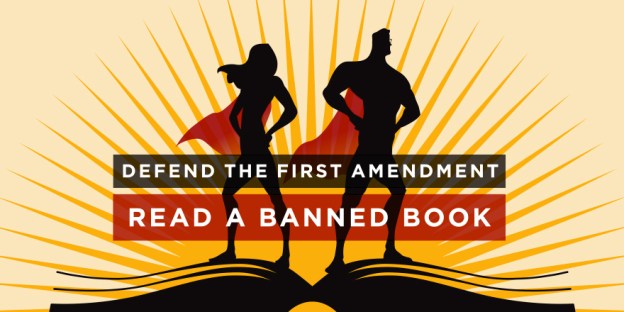
This week marks the start of the annual Banned Books Week! The event was established in 1982 as a way to celebrate the freedom to read and shine a light on the persistent problem of censorship. Organizations across the nation have been participating ever since. This year the celebration takes place from September 25-October 1.

According to the American Library Association (ALA), Banned Books Week “highlights the value of free and open access to information” as well as “brings together the entire book community; librarians, booksellers, publishers, journalists, teachers, and readers of all types, in shared support of the freedom to seek and to express ideas, even those some consider unorthodox or unpopular.”

Since 1982, more than 11,300 books have at least been challenged, meaning a person or group has requested for a book to be removed. In the last year alone, 275 books were recorded challenged by the ALA. Titles of the top ten most challeged books of 2015 include Looking for Alaska by John Green, E.L. James’s Fifty Shades of Grey, and I am Jazz by Jessica Herthel and Jazz Jennings. Books such as these are often challenged for their diverse content.

An infographic on Readers.com explains the reasoning behind these challenges to be primarily caused by books containing offensive language, sexual content, or content unsuited for the age group it is being presented to. Other reasons include violence, homosexuality, religious views, racism, and substance abuse. While some books remain merely challenged, other books suffer a ban from certain countries meaning the book is successfully removed from libraries or being taught in schools.

Banned Books Week celebrates all 11,300 of these challenges. With censorship prohibiting what people can and cannot see or read, it is important to exercise freedom. Turning a blind eye to “diversity” won’t solve anything. This week, and in the weeks following, embrace diversity instead of trying to hide it. Read freely!

For more information on Banned Books Week visit their website or follow their Twitter!

Summer Shakespeare Events

Feeling out of touch with your English friends this summer? Wishing someone would appreciate Shakespeare with you? If you’re in the Delaware Valley area, there are several events worth attending!
Beginning June 10, the Arden Shakespeare Gild presents a new approach to the Trojan War. The Shakespeare 2016 Summer Show includes 9 performances of Troilus and Cressida with a Star Wars theme. Watch a creative take on “Troy versus the Dark Side of the Greeks!” Click here for more information.
Also, on June 25, for those looking or interested to learn more about Shakespeare, Lloyd King will be leading a discussion filled with factual information as well as speculations about an untold side to the playwright. The event is being hosted at Kirkwood Library in Wilmington, Delaware. Admission is free for all ages. For more information click here!
Or you could spend a day in Rockwood Park for the Delaware Shakespeare Festival. This year they’ll be presenting The Comedy of Errors. The festival runs from July 15-31 with a total of 13 performances. Pack a picnic and visit Rockwood’s beautiful grounds and mansion before settling in for some good ol’ fashioned Shakespeare. The festival is family friendly, scheduling a variety of activities including wandering bards as well as a Children’s Activity Tent complete with “Shakespearean-themed arts and crafts.”
 Tickets are on sale as of June 1. For ticket prices click here.
For scheduling and planning information visit their website here.

Check this out!

Staff editor Jennifer Rohrbach has been published on FlashFiction.net. Read her awesome analysis here!

Reflections on AWP 2016

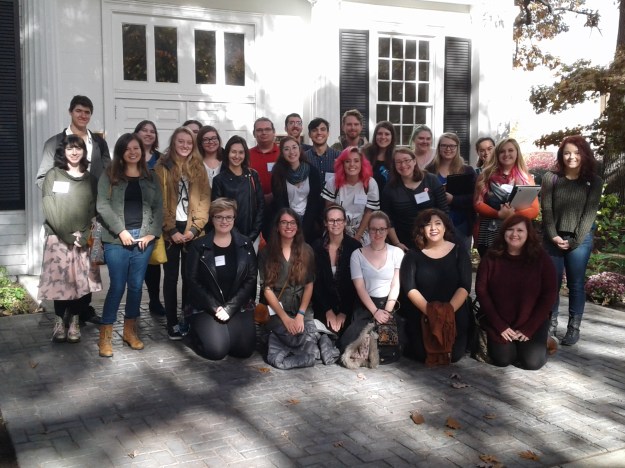
From March 31 to April 2, the conference for Associated Writers and Writing Programs wasIMG_4611 held in Los Angeles, California. AWP is a massive conference that joins editors, writers, teachers, and publishers, from students through veterans of the occupation. More than 12,000 people gather for over 550 readings and panels. Widener’s Creative Writing department was able to attend and brought four students along for the ride this year.

Before coming to AWP, I’d attended FUSE, a national conference for undergraduate student editors. That conference was quite different, and I knew it would be, because it was much smaller-scale and much more tailored specifically to student editors of literary journals. FUSE had also been held at Widener this past fall, so I didn’t even have to travel for that conference. For AWP, I literally crossed the county.

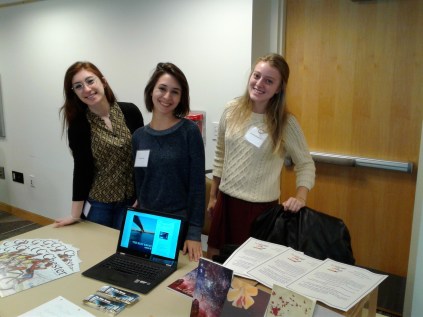
IMG_4594At AWP, there was a FUSE caucus for students both who had attended FUSE and who were interested in attending future FUSE forums. The caucus helped unite undergraduate student editors and students who had become old friends at this point. Undergraduate student editors interested in FUSE should check out their website here! Additionally, FUSE members took turns tabling in the book fair, a huge expo for creative writers. Though the conference was a business venture, being able to run a table made me feel like I was even more a part of AWP.
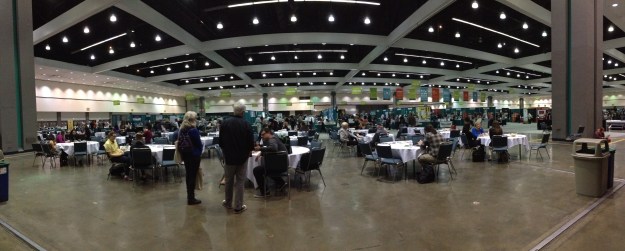
Though I knew AWP was going to be massive and with a lot more to do and see than FUSE, I was unprepared for the size of the book fair. That blew my mind. There had to be a thousand vendors packed into one room—literary journals, MFA programs, the literary journals of MFA programs and so on. There were big presses, like Tinhouse Books and Penguin Random House, and small presses, like Cactus Heart. The New York Times had a stand, as did the MLA. My favorite part of the conference had to be the massive bookfair. I spent hours in that room at a time.

IMG_4596

While in the bookfair I got to discuss people’s literary journals, what people recommended, and how their programs differed than other places. I saw the moderator for a panel I’d attended about writing diverse characters. She and I struck up conversation, and I was able to follow up with her about what she’d discussed.

It was exciting to talk to people from other writing backgrounds as I explored the convention center. It was also wonderful to see so many writers in one place. As one Widener student noted, writers are such versatile and diverse people—you see all types.

Overall, this conference was larger than life. Besides being incredibly informative, it was also incredibly fun! If fellow student editors and writers are interested in attending, talk to your professors and see if there is a way. Next year, AWP will be in Washington, D. C., which is much closer to Widener than California, so you can bet we’ll be there again.

To learn more about AWP, check out their website here.

To read more in-depth about my AWP reflection, including some of the panels I attended and speakers I saw, click here.

Written by Kelsey Styles, ’17

Why Banned Books Matter to You

I was first presented with the concept of censorship in my freshman year of high school with my English instructor’s overenthusiastic ‘celebration’ of Banned Books Week.
In the fourth week of class, I remember walking to my desk to the sound of Mrs. Burrows’ marker squeaking against the whiteboard as she feverishly wrote out the titles of five books: The Great Gatsby, 1984, Harry Potter and the Sorcerer’s Stone, To Kill a Mockingbird and Junie B. Jones. Upon turning around, she asked the class what these books had in common, a question met by a combination of blank stares.

She tried a second time. “What is this week a celebration of?” Once again, she received deafening silence in response. Shaking her head, she scrawled the word ‘censorship’ on the board and thus began a semester long unit centered on the theme of censorship throughout literature and history.

Perhaps due to my own ignorance, and in part due to my school system’s previous lack of focus on the topic, censorship in first-world countries was a new concept to me. I knew of course that it existed throughout the world in the form of government oppression for the purposes of assuring no anti-political media was being fed to the public or no irreligious ideas were being spread in conservative countries. I never imagined, however, that censorship was an issue in America—an issue that is very much a concern today.

The notion that a writer armed with nothing more than an idea and pen could serve as such as a powerful weapon is a curious one. What is it about the written word that so frightens us, compelling governments to implement laws banning the products of an author’s ambition—the compilation of ideas written on the backs of coffeehouse napkins, stories etched into journals with the hope that someday, those very stories would be “enough” to really touch someone in the way only words can. Perhaps this is the very reason literature intrigues so many people just as it repels others. Willingly exposing yourself to a literary work is somewhat of an unspoken consent in allowing another’s ideas to merge with your own. This silent revolution is one world leaders are hopelessly trying to extinguish—feeding words into the mouths of authors with the threat of reducing them to oblivion. Ironically, by limiting the idea authors can share, this threat is already implemented. It is essential for our writers to not fall into this trap—to continue penning their unfiltered ideas—and being willing to brace the criticism doubtlessly endured by all great art. Just as the tragic heroes, the protagonists of our favorite tales must go through hell and back to become victorious, and the brilliance behind these tales, the authors, must take just as difficult of a journey in making the choice between submission to the mainstream literature or the struggle of penning their true words. The takeaway? Write warily, pen with caution, and allow your true voice to resonate.

Written by Nav Kaur, ’18

The Week I Met Wordsworth

Over spring break, I had the brilliant opportunity to travel to the English Lake District (please Google this place, it’s a fairytale land) to study Wordworth in his beloved Grasmere. I cannot stop gushing about my trip; it was life-changing in so many respects, and I’ll take as much time out of my day as you want to show you my pictures and tell you my stories. But one of the greatest things I got out of this trip as an English major was the opportunity to truly connect with an author, to really get to know William Wordsworth as a human being who wrote poetry.

IMG_3531Here I am holding a first edition 1798 Lyrical Ballads. Yeah, that’s what it felt like to hold that book. Even after learning in detail how to pick up, hold, and open a book of such value and age, I was terrified. The process is almost holy, but when completed, it was the most exhilarating feeling. I held the beginning of Romanticism, the beginning of Wordsworth; that book was so much more than just old pages to me.


That day continued with a long walk through the countryside, as we traced Wordsworth’s footsteps through Hawkshead, traveling the same route he walked to get to school. Simply existing in the space he existed in made me realize that Wordsworth was a real person who had a special adoration the natural world that surrounded him. What a surreal moment it was, to look out at the same mountains he looked at, to watch the sun fall through the afternoon just as he would have.

IMG_3537

Hiking through Hawkshead


IMG_3700

The Goslar notebook

I could go on for days. How I touched the Goslar notebook, where The Prelude was born. How I held Wordsworth’s own copy of Paradise Lost, which was 100 years old when he owned it. How at least one person in our group cried everyday out of the intense emotion that comes with truly connecting with an author. How we ate dinner in Dove Cottage and read poems by candlelight. But these experiences are ones that have to be lived to be known. I know that traveling to England is not an option for everyone, but the ability to at once revere an author and know them as a person is absolutely possible for all lovers of literature. You can’t sit in a chair all day and expect to know who an author was. Before, during, and after reading, get out and live the literature you love. Trust me, you will be forever changed for the better.


Written by Emma Irving

To find out more about the Wordworth Trust and all the awesome programs they offer, visit: https://www.wordsworth.org.uk/home.html.

Forget the Hard Stuff: This is Why You Should Fall in Love with Poetry

And, more importantly, fall in love with your own poetry. Forget what your English and Creative Writing professors have taught you. (I know they’re reading this, and I’m sorry, but do it.) Learn how to write for you.

Hi, me again. The obnoxious blogger who reminded you why Percy Shelley was still relevant.  Today I’m reminding you why you should want to write poetry. Here’s the simple answer: it’s FUN.

Here’s the long answer:

Of course writing for classes and publication are different than what I’m talking about here, but remember that poetry should be an exploration. Play with form. Play with sound. Play with images. Poetry is great in its very few rules, and, when you are writing solely for your own enjoyment, those rules don’t exist at all.

I’m not talking about writing sappy love poems after you share a first kiss with someone—though absolutely write those too. I’m talking about putting one word after another just to see what happens. So many students seem to forget what makes poetry so exciting. It’s discovering what you can create with words and images. Poetry is fun because it’s short—you can write a poem in two minutes, if you must—but also because it’s so sound-oriented.

Play with words! Make them your own. You never have to show anyone. Play with rhyme scheme and meter. Do it on your own time. Don’t worry about your class assignments. It is so vital for writing majors to practice the art of writing for the sound of it. Listen to the way the words move. Feel the way they move you.

Let’s apply this to (of course), an old dead poet. My favorite. Langston Hughes.

In case you haven’t read it (though what English major hasn’t?), here it is.

The instructor said,

Go home and write
a page tonight.
And let that page come out of you—
Then, it will be true.

I wonder if it’s that simple?
I am twenty-two, colored, born in Winston-Salem.
I went to school there, then Durham, then here
to this college on the hill above Harlem.
I am the only colored student in my class.
The steps from the hill lead down into Harlem
through a park, then I cross St. Nicholas,
Eighth Avenue, Seventh, and I come to the Y,
the Harlem Branch Y, where I take the elevator
up to my room, sit down, and write this page:

It’s not easy to know what is true for you or me
at twenty-two, my age. But I guess I’m what
I feel and see and hear, Harlem, I hear you:
hear you, hear me—we two—you, me, talk on this page.
(I hear New York too.) Me—who?
Well, I like to eat, sleep, drink, and be in love.
I like to work, read, learn, and understand life.
I like a pipe for a Christmas present,
or records—Bessie, bop, or Bach.
I guess being colored doesn’t make me NOT like
the same things other folks like who are other races.
So will my page be colored that I write?
Being me, it will not be white.
But it will be
a part of you, instructor.
You are white—
yet a part of me, as I am a part of you.
That’s American.
Sometimes perhaps you don’t want to be a part of me.
Nor do I often want to be a part of you.
But we are, that’s true!
As I learn from you,
I guess you learn from me—
although you’re older—and white—
and somewhat more free.

This is my page for English B.

Forgetting content for a minute—which is incredible in and of itself—let’s look at what makes this a fun read. The first amazing thing about this poem is how natural it sounds—it sounds like conscious thought. The second awesome thing is the rhyme scheme that totally is intentional but totally doesn’t sound intentional. Cool, right?

But writing polished poetry with an important message and cool internal rhyme and proper metre and all these other things does take time, and it can become more cumbersome. Less about the fun. So let’s look at another poem.

‘Twas brillig, and the slithy toves
Did gyre and gimble in the wabe:
All mimsy were the borogoves,
And the mome raths outgrabe.

“Beware the Jabberwock, my son!
The jaws that bite, the claws that catch!
Beware the Jubjub bird, and shun
The frumious Bandersnatch!

He took his vorpal sword in hand:
Long time the manxome foe he sought–
So rested he by the Tumtum tree,
And stood awhile in thought.

And, as in uffish thought he stood,
The Jabberwock, with eyes of flame,
Came whiffling through the tulgey wood,
And burbled as it came!

One, two! One, two! And through and through
The vorpal blade went snicker-snack!
He left it dead, and with its head
He went galumphing back.

‘And, has thou slain the Jabberwock?
Come to my arms, my beamish boy!
O frabjous day! Callooh! Callay!’
He chortled in his joy.

‘Twas brillig and the slithy toves
Did gyre and gimble in the wabe;
All mimsy were the borogoves,
And the mome raths outgrabe.

Lewis Carroll’s Jaberwocky is a great example of stretching language to find something new. Carroll is the only one to ever use some of these words, and the poem is fun to read.

Be brave; try new things. Push words around on a page. Speak out loud to yourself. Though something good may come of it, know that you can always write something else later. Poetry for a grade is good, but poetry for yourself, and for the enriching and benefiting of your own mind, can sometimes prove more fruitful in the long run. Remember that poetry shouldn’t be a chore, but something you want to pursue! Remember that you can write poetry for you!

That rhymed. Guess I’m a poet too!


Loss of a Literary Legend: A Tribute to Harper Lee

On Friday, February 19, the world mourned the loss of literary icon, Harper Lee and the following day, at age 89, the beloved author, woman, and friend was laid to rest. The tragic news was confirmed by the mayor’s office in the town where Lee was born, raised, and passed: Monroeville, Alabama. The report was made public by Al.com.

How does one commemorate the life of an author brimming with accomplishments, accolades, and insight? I could spend hundreds of characters recounting definitive biographical details, numerous words reminiscing the immense impact a single author’s piece of literature had on the entire world and anyone that flipped through its pages. I could spend days and countless hours pondering in front of my computer screen, fingers idly hovering the keyboard, knowing that none of the words I want to say are worthy enough for such an influential and inspiring woman.

Only a few had the honor of knowing Lee personally. Several had the privilege to ask her questions and pick the brain that brought us one of the most significant American novels. Others, her readers, knew Lee through her invitation to Maycomb, Alabama, the confident voice of Jean Louise “Scout” Finch, and the admiration of literary hero, Atticus.

In 1960, the world had the pleasure of meeting the small-town Alabama author. Her Pulitzer Prize winning novel, To Kill a Mockingbird, spoke volumes about humanity, justice, and prejudice through the innocent eyes of a child. The novel, dubbed a classic piece of American literature, “has been translated into more than 40 languages with more than a million copies sold each year,” a story that is taught in classrooms internationally.

As a writer, whether To Kill a Mockingbird falls into your lap during a high school English class or you stumble upon it on your own accord, Lee has so much to teach you. First and foremost, Lee teaches us what it’s like to be a writer. She exemplifies the success, the obstacles, the hardships, and the passion for the craft.

In a 1964 interview conducted by Roy Newquist, Lee divulged ample words of wisdom pertinent to aspiring writers and a testament to her legacy.

She demonstrated that it’s okay to write about what is familiar. There are several parallels that can be drawn between life in To Kill a Mockingbird and the life of Harper Lee. Hints of her lawyer father, Amasa Coleman Lee, live in Atticus Finch from occupation, to values, to the defense of African American men in trial. She pulled aspects of herself to shape strong-willed protagonist, Scout. Even the southern setting, Maycomb, Alabama parallels Lee’s hometown. Lee took what she knew, fused it with empowering words, a compelling, impactful story-line and unforgettable characters. She took a small-town story and paired it with realistic American issues to create this overnight classic.

Lee taught us the importance of empathy and characters in saying “Characters make their own plot. The dimensions of the characters determine the action of the novel.” To Kill a Mockingbird gifted the world with memorable characters that will live on in the midst of Lee’s legacy. You become a part of Maycomb’s community. You love, admire, and look up to Atticus as Scout does. You inhabit a sense of childish innocence and sense of adventure with Dill, Scout, and Jem. You want to protect the introvert, Arthur “Boo” Radley just as much as he wants to protect the kids. You feel what they feel, learn what they learn and keep in the back of your mind Atticus saying, “You never really understand a person until you consider things from his point of view—until you climb into his skin and walk around in it.”

Lee taught us that if it is a passion, you need to pursue it. Writing is time consuming. It demands full and undivided attention. Lee was fortunate enough to be given the gift of financial support from a close friend, so that she could devote herself to writing full time. She says, “I like to write…when I get into work I don’t want to leave it.” And, with that devotion, with that passion, Lee cannot stress enough that writing is something one must do for themselves. The young writer cannot sit down to write with the intention of getting rich, receiving praise, and to create something for the world. Writing like that loses authenticity. She believes, “You must come to terms with yourself about your writing. You must not write “for” something; you must not write with definite hopes of reward…Writing is selfish and contradictory in its terms. First of all, you’re writing for an audience of one, you must please the one person you’re writing for….Any writer worth his salt writes to please himself.”

It is surreal to think that a woman that could teach the world so much could be taken from our lives. Harper Lee was always someone I believed to be immortal and, in some ways, I still believe she is, because Harper Lee loved to write and in doing so she placed a little bit of her soul into whatever she left behind. Harper Lee will live on in her novels, in her characters, in her tremendous contribution to society. She writes in To Kill a Mockingbird, “Mockingbirds don’t do one thing but make music for us to enjoy . . . but sing their hearts out for us.” Thank you for singing your heart out Harper Lee.

Written by Carlie Sisco

(Image by Chip Somodevilla / Getty Images)

6 Things Wrong with Shakespeare’s “Epic Romance” Romeo and Juliet

Valentine’s Day; a holiday chock full of passion, romance, and chocolate. For some, the day is awaited with eager anticipation of receiving flowers, gorging ourselves heart-shaped candy, and spending time with a loved one. For the rest, we barricade ourselves in our room with a bowl of popcorn and nurse our lonely hearts by binge-watching Netflix. But what ever happened to good ol’ romance? Where are the heartfelt declarations of love? Perhaps you fill this void by reading Shakespeare’s celebrated Romeo and Juliet, a tale of star-crossed lovers destined for tragedy.

Well, this year I highly encourage you to reconsider your choice of literary satisfaction, because I’m here to tell you 6 things that are wrong with Shakespeare’s Romeo and Juliet, and trust me; after this, you won’t be longing for a Romeo to come clambering up your balcony any time soon.

1.They knew each other for a day

I can’t even imagine going on a date with someone I’ve known for less than a day, let alone marrying them. For those of you who might be a bit fuzzy on the finer details, the timeline of Romeo and Juliet goes like this; on Sunday night, Romeo goes to the Capulet’s party. He and Juliet lock eyes and fall passionately in love. They get married the next day and die a few days later. The end.

This famous Shakespearean tragedy was based on Arthur Brooke’s 1562 narrative poem, Tragical History of Romeus and Juliet, which was taken from another fable, which was taken from another. Seriously, the story behind this play is ancient. Shakespeare published his play thirty-five years later, in 1597. Brooke’s version may be a little drier, but their relationship took place over nine months, which allowed for a more development than Shakespeare’s condensed version, which happened in less than a week.

2.  Juliet is the rebound

After Romeo gets friend-zoned by Rosaline (who has taken a vow of chastity), his Montague bros take him out to a party to forget about her, “By giving liberty unto thine eyes. / Examine other beauties” (1.2.225). Here he sees Juliet and enters into a whirlwind romance that seems completely unrealistic today, unless you need a green card or get drunk in Vegas and make questionable decisions. And even if he does truly love her, our precious, naïve Juliet is nonetheless Romeo’s rebound in an attempt to mend his broken heart and piece together his shattered manhood.

3. In Romeo’s case, “creepy” is often mistaken for “romantic”

Sure we all know Romeo’s legendary pickup line: “O then, dear saint, let lips do what hands do / They pray; grant thou, lest faith turn to despair” (1.5.102). But using religion to coerce her? Okay, I might be exaggerating, but doesn’t this seem a bit like Romeo is forcing himself on her? And this is not the only time he does it.

After the party ends, Romeo creeps around Juliet’s backyard until he sees her on the balcony. He does not tell her that he is there, but listens to her private musings. Upon his exposure, Juliet says, “What man art thou that thus bescreened in night / So stumbles on my counsel?” which is pretty much saying “WTF dude?”

Romeo proceeds to flatter her with words of love that—let’s be honest, would probably win over anybody, male or female—until he forces her to say the big ILY. At first Juliet shows promising signs of sensibility and refuses him, saying, “Although I joy in thee / I have no joy of this contract tonight; / It is too rash, to unadvised, too sudden” (2.2.116-118). However, Romeo then guilt’s her into professing her love, crying, “O, wilt thou leave me so unsatisfied?” and asking for “Th’ exchange of thy love’s faithful vow for mine” until she finally gives in (2.2.125-127). Keep in mind, this takes place only hours after they met.

4. Marriage

Okay, so this one isn’t bashing on Romeo, but on Juliet’s other suitor, Paris (if you can even call them suitors). At first, Capulet, Juliet’s father, wants Paris to “woo” Juliet because he values her consent. Juliet’s mother thinks he’s beautiful, so she cannot fathom why Juliet would be opposed to the marriage. Later, when Juliet is upset about Romeo’s banishment and Tybalt’s death, Paris (now with her father’s blessing) tries to force her into a marriage, which makes her take ridiculously extreme measures to get out of it. Neither Paris nor Romeo actually court Juliet, which makes me kind of feel bad for the girl.

5. Family does not seem to be a priority

Romeo finally gets over Rosaline by latching onto Juliet, who is none other than Rosaline’s cousin! (Somebody has a thing for Capulets)

There’s also the whole thing that hey, nobody else—not even Juliet’s trusted nurse—thinks this relationship is a good idea, but they do it anyway! YOLO

Granted, there are a lot of great themes in this play, such as the pointlessness of blind hatred perceived through the feud between the Capulets and Montagues. This tension culminates in the scene where the two sides fight for their pride, which only leads to meaningless death and suffering. Tybalt of the Capulets hates Romeo because he’s a Montague, and because Romeo won’t fight him (none of them know of his marriage to Juliet), his friend Mercutio impulsively decides to fight Tybalt himself, and is promptly killed. In a fit of rage, Romeo kills Tybalt, Juliet’s beloved cousin, to avenge his friend’s death. Apparently “an eye for an eye will only make the whole world blind” hadn’t been written yet. (Gandhi, by the way, and he was born in 1869)

Juliet basically says, “Romeo killed my cousin, my childhood companion, my own flesh and blood! But then again, Tybalt would have killed Romeo, who I have been married to for three hours and have known for about a day, so you know, the pros outweigh the cons.” Basically. Loosely translated. Anyway, then she doesn’t even want to mourn Tybalt’s death: “Wash they his wounds with tears? Mine shall be spent, / When theirs are dry, for Romeo’s banishment” (3.2.130-131). She won’t cry for her dead cousin, but will for her banished husband of three hours? I don’t know about you guys, but I think she really needs to sort out her priorities. (Harry Potter, anyone?)

6. Pretty much every one dies because of two kids’ infatuation with each other

I mean seriously, why is something so violent, corrupt and bloody considered one of the greatest love stories of all time? I guess there are the good elements, that love conquers all (except, you know, death), tragedy can bring people together, the individual versus society, and the inevitability of fate, but seriously; do yourself a favor and read Wuthering Heights or Pride and Prejudice. They’re much more satisfying.

Written by Jennifer Rohrbach

Used the Bloomsbury Arden Shakespeare 2012 edition

New year, new issue!

Welcome back everyone! To kick off a new semester, we’ve launched Issue 15, which can be viewed here! These pieces truly are the best of the best…out of the dozens of submissions we received last semester, the 8 featured in this issue truly blew us away! Take this relaxing Sunday to read each piece in the issue and get inspired, because we are reading submissions for Issue 16 now through March 1st!

Continue to follow our team this semester by liking us on Facebook, following us on Twitter, and keeping up with the blog here. Best wishes for a successful and happy spring semester from everyone at the Blue Route!