Category Archives: Uncategorized

Community Bridge Bridges Community

Lately, there’s been a huge push on our campus to connect the city of Chester and Widener University through art…we love it! Staff member Kelsey Styles tells more about the latest of such events, Boundaries and Bridges, which seeks to both strengthen the art and cultural presence in the city, as well as connect the university to the city.

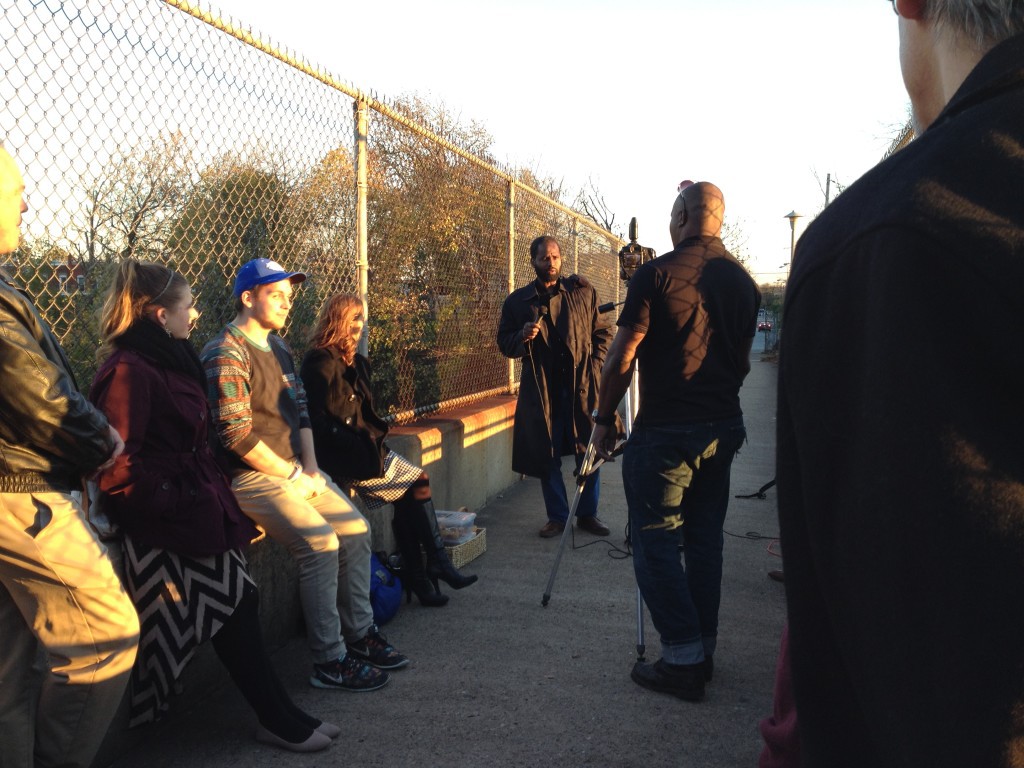
On November 13, students, faculty, and professors of Widener University meshed with members of the community on the Walnut Street Pedestrian Bridge as part of the much larger Boundaries and Bridges project.

John Carr performs a song for Devon Walls' promotional Boundaries and Bridges video.

John Carr performs a song for Devon Walls’ promotional Boundaries and Bridges video.

The hum of engines pulsed in the background, but that did little to deter performers as they stood in front of Devon Walls’ camera and read their work or talked about their projects or sang songs inviting change. Some cars honked up at them, but that only encouraged the crowd. To Walls, a Chester artist, their noise promotes notice. It means people are wondering why so many individuals are hanging out over Interstate 95.

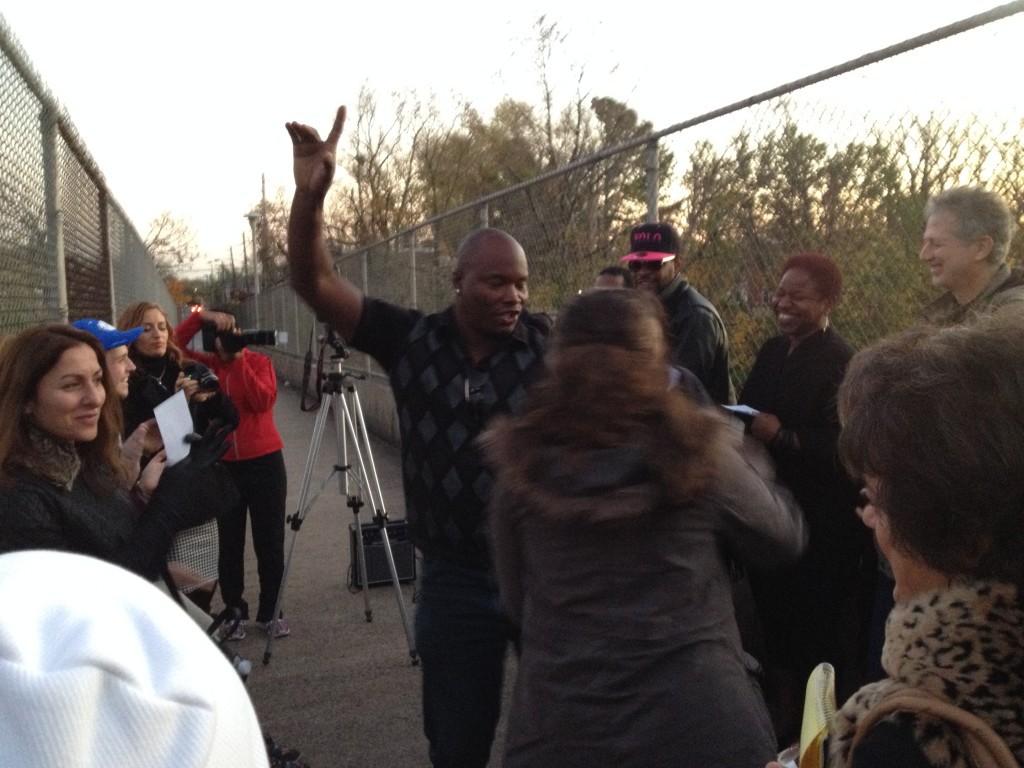
At the end of the event, attendees dance and have fun as part of a larger celebration.

At the end of the event, attendees dance and have fun as part of a larger celebration.

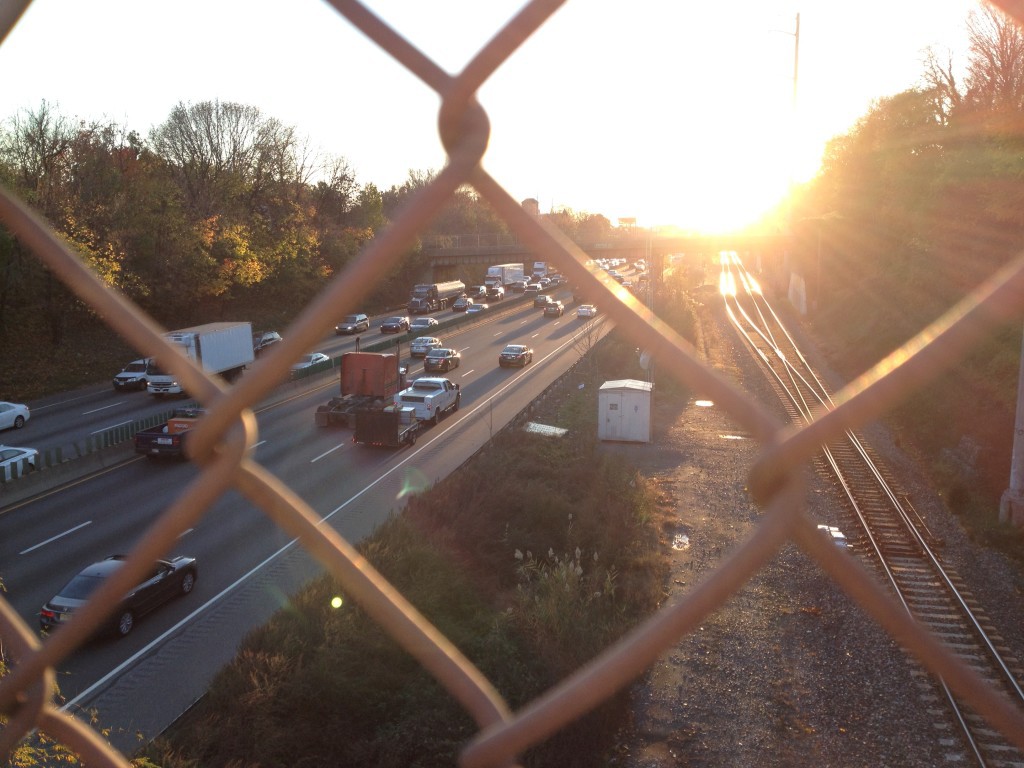
The Walnut Street Bridge doesn’t connect the communities between Widener and Chester—it separates them. The highway whirring underneath acts as a wall between one group and another. The goal of Boundaries and Bridges is to mend these two broken worlds through art, because art is the medium connecting all living things.

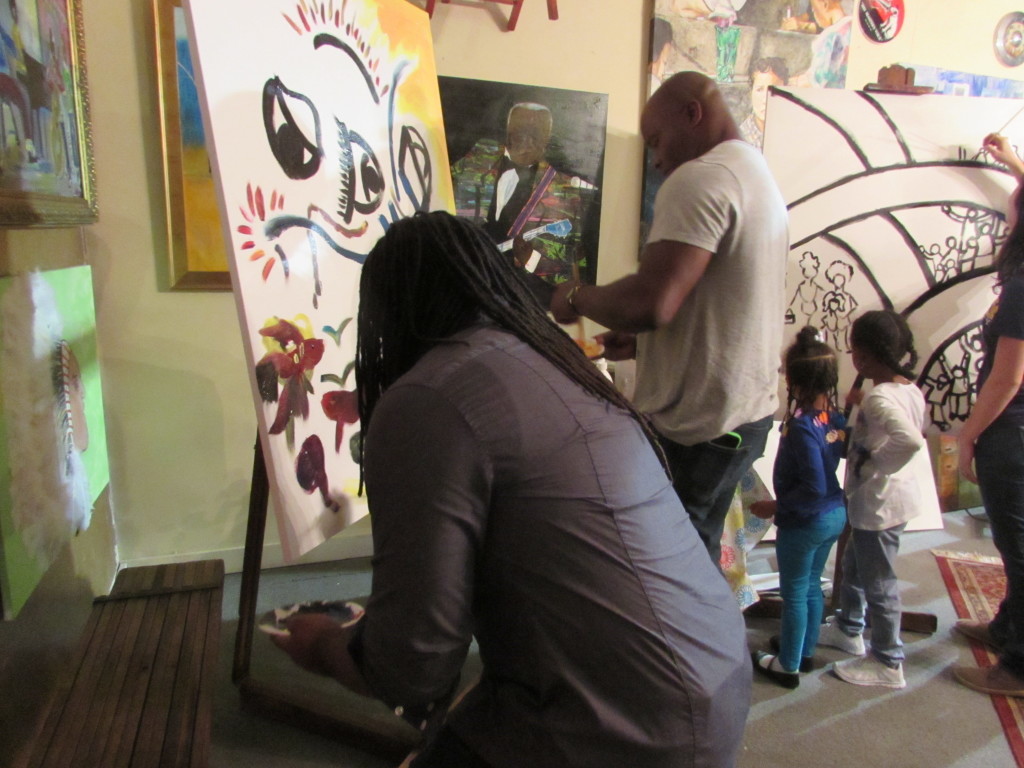
Artists collectively share canvases to create a joint masterpiece as a symbol of what the Boundaries and Bridges program aims to do.

Artists collectively share canvases to create a joint masterpiece as a symbol of what the Boundaries and Bridges program aims to do.

The program truly kicked off the Friday previous when an information session was held discussing what the program planned to do after it received a Catalyst Grant from the Barra Foundation, which “works to advance Greater Philadelphia’s culture of innovation.” The goal of Boundaries and Bridges is to both strengthen the art and cultural presence in the city, as well as connect the university to the city.

Blue Route staff member Kim Roberts takes her turn with a brush.

Blue Route staff member Kim Roberts takes her turn with a brush.

Widener students, children, and members of the community all worked to create a new piece of art.

Widener student, children, and members of the community all worked to create a new piece of art.

To find out more, like the Boundaries and Bridges page on Facebook, or visit The Artists Warehouse on 515 Avenue of the States in Chester. It’s time to move with the movement, cross that boundary, and build a bridge. What is your university doing to spread the arts around your community? Comment and let us know!

blue and gold 2

By Kelsey Styles ’17, originally published on The Blue&Gold

Happy FUSE Conference Week!

It’s finally here! From everyone on the staff at the Blue Route and all those in the English & Creative Writing department and beyond, we cannot wait to welcome everyone to Widener to have an awesome FUSE conference!

The theme of the conference this year, “Will You Look at That?” places a focus on aesthetics and its interactions with such topics as individual publications, the process of evaluating submissions, the digital realm, and the community. We’ve got two and a half days packed with panels by student editors from 14 different universities around the country, as well as some awesome special events such as:

  • Keynote speaker Lisa Funderburg, the author of Pig Candy, speaking on Thursday afternoon
  • Special Presentations by professional editors and Widener faculty, as well as one by Widener students engaged with textual scholarship
  • Fun evening activities like an Open Mic hosted by the English Club and a concert by Smart Barker (rock-n-roll with a literary twist)
  • A Saturday morning excursion to the Brandywine River Museum to finish out the conference

Remember to take tons of pictures and hashtag everything with #FUSE15 on social media so we can live tweet the conference!

It’s going to be the best FUSE conference yet…see you soon!

Written by Emma Irving

Moore, please!

Dinty W. Moore recently visited Widener’s campus as part of the Distinguished Writers Series. Throughout the week he met with students who have been reading his creative nonfiction books and essays in class and a shared a few selections from his new book, Dear Mister Essay Writer Guy, at a public reading on Wednesday. As a published author who has taught creative writing at multiple universities and has been writing for over 30 years, Moore had a lot of insightful advice for aspiring writers, which he generously shared:

1. What’s important about writers is what they say

Every writer has their own voice, “which is going to be different from any other voice,” said Moore. “That is something that can’t be taught. That we have to discover.” He also emphasized the importance of trial and error and repetition for a writer. “Your first draft is you wandering around the page trying to figure out what’s going on.” For him, the first few drafts are the hardest parts of the writing process. He writes the first draft of a book or essay solely to help him figure out what he is trying to say. Only during later drafts, when he understands what needs to be said, does he writes with the reader in mind.

2. You need curiosity to be a writer

To truly discover your own voice and figure out what it needs to say, you have to ask questions. “The trick,” he explained, “is not knowing what you want to say, but to be curious. Have questions. Discovery is starting with a question and working the answer out on the page.” Curiosity about a subject is a quality that all good writers have. One debate in the literary world is if creative writing is something that can be taught. Moore believes so. “There’s a lot about writing—including creative writing—that can and should be taught,” he said. “Students take math so they understand a little bit more about how mathematics works, and students take science classes to understand how science informs the world,” he said. “I think if you take a writing class, and you don’t end up being a writer, it still opens the mind and lets people see how a certain part of the world works and thinks…You can’t teach creativity, but you can encourage it.”

3. There’s no such thing as writer’s block

“Writer’s block is when you listen to the voices in your head that say you can’t do it,” Moore said. The solution? “Talk back to the voices. Say, ‘I hear you, but I’m going to ignore you and write this now.’”

That’s easier said than done. But in his book, Crafting the Personal Essay, Moore dedicates an entire chapter to the idea of writer’s block and how to push through it. You’ve got to “Expect the Negative Voices” and “Expect a Lousy First Draft” (literally the section headings of this chapter), and realize that “the true definition of writer’s block is when the writer gives up.” You’ve got to keep trying. Which brings us to our next writing tip:

4. Persistence

Moore has a busy life teaching, writing, traveling, and just living in general. In order to make time for his writing, he implements the “ass-in-chair” method; he gets up early in the morning, sits down, and makes himself write for two hours a day. It’s not easy, especially for college students, to make writing a part of our daily schedule. For some who juggle classes, work, and a social life, writing can get pushed to the background. Moore suggests that aspiring writers set goals for themselves. “Maybe watch 6 hours of football on the weekend instead of 10,” he joked. But he is right; schedule some time to sit down and focus on your writing. Make it a priority.

Another piece of advice Moore offered is to make a lot of mistakes. “Write a lot of failed poems or failed stories,” he said. “You learn the most from trial and error. It’s like trying to learn how to play tennis. You get out there and swat at the ball and make a total fool of yourself. If you do that for two or three days, you won’t become a wonderful tennis player, but you’ll start to get a little bit of control. Eventually you’ll hit something that goes straight over the net. If you practice long enough you may not become Serena Williams, but you’ll be able to play tennis, and as wonderful and mysterious as the art of literature is, writing is kind of the same.”

If you’re craving Moore, be sure to check out Dear Mister Essay Writer Guy: Advice and Confessions on Writing, Love, and Cannibals, Moore’s newest book of and on essay writing, available now.

Written by Jennifer Rohrbach

Why English and Creative Writing Majors Should Acquaint Themselves with Percy Shelley

Here’s the simple answer: Shelley wants to make you cool again.

Picture from poets.org

Picture from poets.org

Percy Bysshe Shelley wrote, among other profound and fantastic things, “A Defense of Poetry.” If you never read a single thing by Shelley after this, it would be your loss, but not the end of the world. Ignoring “A Defense of Poetry” as an English kid should make you question your identity.

Shelley believes that poets are like philosophers, and that they should hold power in society. “Poets, or those who imagine and express this indestructible order, are not only the authors of language and of music, of the dance and architecture and statuary and painting: they are the institutors of laws, and the founders of civil society.” Poets, according to Shelley, “essentially comprises and unites both” the legislators and prophets of the world. How do they do it? “In the infancy of society every author is necessarily a poet, because language itself is poetry; and to be a poet is to apprehend the true and the beautiful.”

Shelley said that people who read poetry “open themselves to receive the wisdom which is mingled with its delight.” When a poem is good, the reader feels like he or she has gained a token of wisdom, which in turn causes the reader to feel pleasure. (For other writing on the power of good poems, “The Limits of Indeterminacy: A Defense of Less Difficult Poems” by Charles Harper Webb is an excellent resource.) Granted, this is not the only way to read poetry; people read poetry for sound, for pleasure, etc. But when people gain something from the poem—when the kicker hits a reader at the end—that moment is so much more likely to be pleasurable for that reader. This is what makes poets so great: They can teach in the best way, for “Poetry is ever accompanied with pleasure.”

Shelley goes on to say that “Poetry, in a general sense, may be defined to be ‘the expression of the imagination.’” Poetry, then, “is connate with the origin of man.” The use of the word connate here is essential; it means that poetry is innate. It also means that poetry has grown out of man, from pieces into a whole form. Shelley describes the ways in which early language played with poetry in sounds and words. Grammar came next in the building of language, followed by form. “Every original language near to its source is in itself the chaos of a cyclic poem: the…distinctions of grammar are the words of a later age, and are merely the catalogue and the form of the creations of poetry.”

So according to Shelley, poets are the greatest teachers we have. They are the best resource to understanding life and love and everything right and wrong with the world. And unlike others of his time, Shelley is willing to open up his definition of poetry. “Yet it is by no means essential that a poet should accommodate his language to [this] traditional form…The practice is indeed convenient and popular, and to be preferred…but every great poet must inevitably innovate upon the example of his predecessors in the exact structure of his peculiar versification.” Listen, creative writing majors of all genres: “The distinction between poets and prose writers is a vulgar error.” Is not a prose writer also expected to choose the best possible word to be used in the best possible place? Some may debate on this, however, ultimately the writers of prose will certainly argue that they’ve written the best piece they could. “The parts of a composition may be poetical, without the composition as a while being a poem.”

Shelley expands on this idea further by saying that “A single sentence may be considered as a whole though it be found in a series of unassimilated portions; a single word even may be a spark of inextinguishable thought.” Some writing is so powerful that it may stand alone, though it is only a few words out of a larger text. In other instances, Ezra Pound’s “In A Station of The Metro” is a mere two lines, but the words stick. Haikus are seventeen syllables total—but we all classify that as poetry.

Why defend poetry? “A poem is the very image of life expressed in its eternal truth.” Poets are commentators on our world. Listen to them, for they exist to guide us down the path of moral good. Listen to them; let them pump magic through the veins of our imagination. Listen to poets who lift “the veil from the hidden beauty of the world.” Let them make “familiar objects be as if they were not familiar.” Listen to them as they play with sound and mind and soul.

Listen to us.

By Kelsey Styles

What’s on your October Reading List?!

Happy October everyone! With the semester in full swing and the FUSE conference just 5 weeks away, things are getting pretty hectic for us at the Blue Route, and we’re sure you’re feeling the stress too! But fall is in the air and despite all the craziness, it’s important to take time out of the day to relax, enjoy some sort of seaonsally-inspired coffee drink, and read something not for a class. Whether it’s a fun blog, that YA novel your best friend has been bugging you to read for months, or a ridiculous high-fashion magazine (my personal favorite), use this fall to check out media you don’t always take the time to read. What’s your go-to fall read this season? Comment and let us know!

The Pursuit of Understanding Classic Reading from A Modern Perspective

My freshmen year of college introduced a new element of the publication of books that, I am certain, had I not pursued the furthering of my education, I never would have known. Reflecting now, as a junior, on my wealth of knowledge and inherent lack of it as well, I do know that I can never regress into not knowing what I have learned.

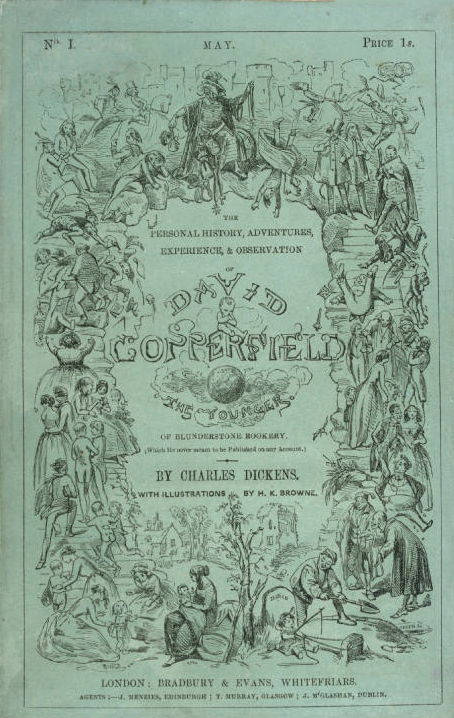
Textual scholarship is a layer of the publishing world that focuses on the origin of texts, usually manuscripts when considering the works of authors done in the 19th century and before, and preserving them as they were first originally published. (That is my favorable approach to textual scholarship but I will say some scholars approach texts with different means.) So imagine my excitement when having a conversation with a professor and he mentioned that Charles Dickens had published his novels in monthly installments! As a modern reader in the modern world there is hardly any piece of literature that is trickled out slowly to me, especially Dickens. I can pick up, say, David Copperfield and flip through every chapter until I’m satisfied. But Dickens wrote David Copperfield in a way that reflected how it was published.

So, in the pursuit of finding out what it is like for a modern audience to read the text of David Copperfield in a very slow, un-bingeful way, a small group has taken a step towards preserving its original structure. Each installment of David Copperfield, there being 19 of them, is distributed monthly with all engravings provided to recreate the response Dickens was going for originally. Each piece of this installment has significance that is lost to many readers when trudging through Copperfield in its complete form. But that’s where the purpose of pursuing the preservation of this novel begins to gain momentum.

Here’s to hoping that a modern audience learns more about their modernity when reading something in a very classic, out-of-date, bizarre way. Here’s to hoping the readers engage with and understand Dickens on a deeper level, like his original readership did. Here’s to preserving, and here’s to textual scholarship.

By Kimberlee Roberts

Lots of Important Stuff…READ THIS!!!

And just like that, you’re back on campus like you never even left…happy new school year everyone! On behalf of the whole Blue Route staff, I’d like to wish all our contributors and followers a successful start to the new semester! A lot of exciting things are happening on our tiny campus in the new future including a new submission period for our next issue (see details here) and best of all, the 2015 FUSE Conference (check it out here)! The blog staff will be bringing you all the latest updates of conference preparation/journal publication, so do not hesitate at all to contact us with any questions. And please, take literally 3 minutes to like us on Facebook (The Blue Route), follow us on Tumblr (wublueroute), and keep up to date with us on Twitter (wutheblueroute). And while you’re at it, go follow all the undergraduate literary journals you can find on social media! There are so many amazing things being created and discussed by students in these publications…they all deserve to be supported.

Happy New Year!!!

Written by Emma Irving

Reflections on the Managing Seminar for College News Editors

English and Creative Writing students often have so many opportunities to show off their skills in various university clubs and organizations, including school newspapers! Here, Kelsey Styles reflects on a journalism conference she attended in July and gives us a peek at the interesting world of college journalism.

I never would have considered breaking news to be something I, a mere student, should be thinking about. However, two weeks ago at the Managing Seminar for College News Editors (MSCNE15) in Athens, Georgia, I realized that I could make an impact. Were something to happen on campus, students could be the first ones there—we could beat NBC and CNN if we’re fast enough!

Going into MSCNE, I wasn’t sure how to feel. My brain was stuck on the concept that attending would mean I’d have to do work (in the summer, no less). Even up through the orientation dinner, where event coordinator Cecil Bentley explained that sessions would run from almost 9 am to 9 pm each day and that we’d need to complete projects in our free time on top of that, I was concerned. What had I gotten myself into? But by the end of the next full day, I knew I was in the right place.

Despite one or two bores, most seminars were entertaining, informative, and eye-opening.  One session, “Journalism of Ideas” by Dan Reimold, was an hour and a half of generating stories worth reading. What I loved about his session was that he didn’t just stick to traditional storytelling. He discussed ideas that could create a buzz, like short interviews with students that could be posted to social media, picture galleries of the weirdest graffiti on campus, and professors reading reviews (like the ever-famous “celebrities read tweets about themselves” video series).

Of course, the conference wasn’t just about fun with social media. The advising professors spent a lot of time discussing the proper execution of a breaking news piece and students got to explain some of their proudest investigative pieces. Throughout the week, we were expected to write a feature piece on the city of Athens using several multimedia tools. My group’s site, found here, has a full-length story along with a map, infographic, picture gallery, and video. We were told to play to our weaknesses, so I learned how to make an infographic, and made both on that website!

On Thursday, we had a breaking news exercise where we had the chance to, as one speaker put it, “get it first; get it right”. This was especially cool because it was my first experience covering an event in real-time. I had a chance to play photographer while others conducted full interviews and wrote pieces. My phone was constantly buzzing as members on the scene relayed information back to the office, while the students there fed us questions to ask.

In another room, MSCNE15 advisors continued refreshing our sites to see who had the most up-to-date information and who was first to complete their articles. At the end, a mock press conference was held, and then a press release was finally sent out. After the exercise, we were all called in for “the beat down,” as one staff member called it. The professors ripped our sites to shreds, telling us how many things we’d messed up or gotten wrong. Though the actual breaking news exercise was exhilarating, the end was sobering; as the professors explained, we only get one chance in the real world.

At the CNN World Headquarters in Atlanta, Georgia!

At the CNN World Headquarters in Atlanta, Georgia!

Though the breaking news exercise was perhaps the most informative of the entire week (the hands-on aspect of the experience was so valuable), I also feel so lucky to have had the opportunity to visit the CNN World Headquarters. The conference we had with Paul Crum, the CNN Vice President of U.S. news operations, as well as various other official CNN reporters, was truly gratifying. The conference was one of those experiences that almost didn’t seem real—am I actually in a room with the best of the best in this business? – until the head of internships came out and began answering questions about how to apply. I know I have a lot to improve upon, and I may never be accepted to work for CNN, but the opportunity to be in that room and have the head of CNN’s internship program offer insider information about how to get involved there made me feel like I was worthy—like I could actually do this for a living one day.

I absolutely loved attending MSCNE15, more than I can explain here. Not only was it informative and exciting (which are two things every good conference should be), but it was almost a relief. My absolute delight with everything – even the boring two-hour seminars I sometimes had to struggle through – was an affirming sign that I’m in the right place and doing exactly what I love to do in life.

By Kelsey Styles

“You Must Contribute Brain!”

You haven’t seen the inside of a book in over two months, and you ask yourself, why?!?Summer, that’s why. It is natural human laziness to leave the doors of the University behind and shut down your mental and literary expansion despite your best wishes to conquer that summer reading list (It’s growing in the corner of your room, neglected, cold, and shunned…). But the challenge is to continue to immerse yourself in opportunities of learning, however simple it may be, perhaps with adult literature or a great classic.

So here’s what I’ve learned forcing myself to read this summer.

The OBVIOUS benefits of using your literary brain over the summer:

1. You will be able to recall the things you’ve spent the entire semester stressing over!
–Remember how many times you re-read “Kubla Khan” by Samuel Taylor Coleridge just so you could get to the bottom of what was really going on? Yeah, reading more literature over the summer enables you to bring that trained cognitive thought process back to the surface without as much work, thus making you smarter!

2. Your conversations will have more depth than the obvious focus on the weather and tanning!
–All of sudden you come to a revelation and BOOM! you’ve gotta talk about The Parable of the Cave from The Republik by Plato, and how you’ve crawled out and can stand in the glory of the sun! So much more interesting than the typical tan line conversation, and surely a lot less embarrassing if your tan lines aren’t even that impressive…it happens.

3. You’ll be able to see all of the neat little references in the newest summer blockbusters!
–That’s right, they’re everywhere. Not everyone gets them, but you will!

4. It will disconnect you from the eternal connection that is social media.
–You, a book, maybe some coffee and plenty of time to live within the narrative of something great is all you really need.

5. Your imagination will grow exponentially!
–LOOK AT HOW SUDDENLY CREATIVE YOU ARE!

I’ve been indulging in a few novels that have surely made an impression on my summer. If anyone is looking to begin their summer reading, I would highly suggest Tom Hardy’s Jude the Obscure, or Charles Dickens’ David Copperfield! Remember, just because the sun is out and the sky is blue doesn’t mean your literature doesn’t want you too! So, READ ON!

Kimberlee Roberts

*Title credit to Daniel Robinson, Smart Barker

Fall Submission Period, Aug. 1-Oct. 1

The Blue Route will be accepting submissions for Issue #15 from August 1-October 1. Undergraduates, please send us your best fiction, creative nonfiction, and poetry during that window. For more information, see our submission guidelines.