
by Abigail Grossman
At the end of October, I attended a Revolutionary Reads lecture by Dr. Erica Armstrong Dunbar, an historian who came to Widener University to talk about her book Never Caught: the Washingtons’ Relentless Pursuit of Their Runaway Slave, Ona Judge. The book tells the story of an enslaved woman who was able to escape from captivity. Her owners, George and Martha Washington, stopped at nothing to recapture her because they viewed her as property. It all began when Washington came to Pennsylvania to serve in Philadelphia. Pennsylvania had different laws concerning slavery than Virginia. Enslaved people had to be set free after living in Pennsylvania for six months. However, Washington found a loophole by sending his slaves to different states before their freedom came. Eventually, Ona had enough and seized an opportunity to escape to New England.
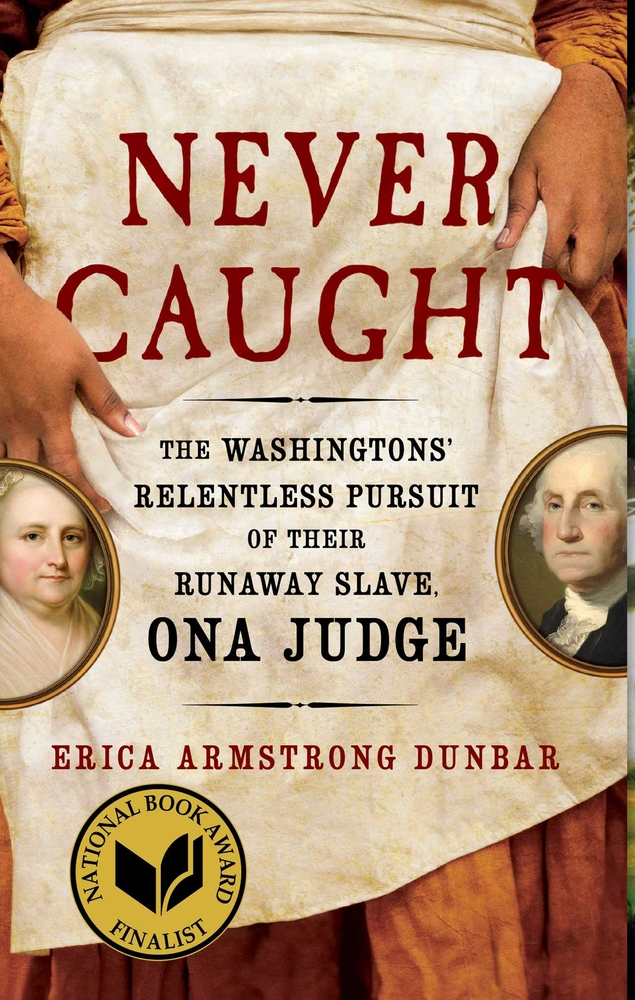
Dr. Dunbar began by introducing herself. She was born and raised in Philadelphia, Pennsylvania and studied history for many years and taught at various universities. Currently, she is a professor of African American studies at Emory University. She told a story how about watching the Roots mini-series with her family when she was young inspired her to study of African American history. During research for her first book, she found an advertisement the Washingtons had posted for Ona’s recapture, a discovery that led her to author a story of American history through the perspective of an enslaved woman.
Dr. Dunbar continued by providing some background information on Ona Judge. I learned that she was born in the 1700s and taken to the Washington’s at 10 years old. Martha Washington decided that Ona would be her “go to” enslaved person. When Washington became President, Ona had to travel to Philadelphia with the Washingtons. However, slavery “was almost dead” in Philadelphia, and she became “a marker of Washington’s commitment to slavery.” This lead to Washington finding out that his slaves would be set free after six months because of Pennsylvania law. However, he overcame this law by sending Ona and his other slaves from state to state so that they would not be set free. In a private letter, he described this process as an effort to deceive both the slaves and the American public. Eventually, Ona found an opportunity to escape enslavement, and Washington pursued to recapture her for a long time. Luckily, she was never caught and lived very carefully in hiding so that she never would be.
At the end of her visit, Dr. Dunbar answered questions from the audience. I was able to ask a question that was on my mind throughout her talk. I thought a lot about Dr. Dunbar’s success as a writer and historian. As an English and history major, I am easily discouraged when hearing that many people think studying humanities is unimportant or unnecessary. I often find myself wondering if what I study is worth my time and effort. So I asked Dr. Dunbar if she had any advice to a young, aspiring writer and historian like me. She explained that the skills — like critical reading and writing — learned through studying humanities are important in the workforce. Her answer inspired me to rethink my doubts about my choice in majors and have the courage to continue to pursue studying humanities.

